
"Write a play. Put it up."
an afternoon of mentorship in Oscar Hammerstein's living room

This past Saturday, I had the chance to do something I still can’t quite get over: I led a playwriting workshop for young writers in Oscar Hammerstein II’s living room.
The idea for this project began three years ago after my first tour of Highland Farm. This is the house where Oscar Hammerstein II lived when he collaborated with Richard Rodgers on their blockbuster works. It is also the home where a very young Stephen Sondheim found refuge and asked a question of Oscar that sparked a legacy of mentorship that has spanned 80 years. So on that tour, I was overcome with the spirit of the place.
It was in this house where young Stevie, as he was called, asked Oscar to read and critique a musical he wrote for his classmates at nearby George School and to treat him as if he was an adult, professional artist. That moment, and the resulting conversations and writing assignments, launched a legacy that Sondheim carried forward as mentor to up-and-coming theatre artists and teenage writers around the world. All of this was done with the same seriousness that Oscar showed him as a young man.
It’s easy to be gentle with young writers. The propensity to place platitudes onto young people is well-intentioned, but misguided. It is done as a way to be encouraging and to not crush the aspirations of the young person creating the work, but wrongly assumes they are not capable of real art. This doesn’t serve them well. When Oscar gave feedback on Stephen Sondheim’s play, he took it seriously and focused on the work alone, without care for Stevie’s age. Sondheim was also open to learning from the experience, which prompted his growth into the artist we know he became. Because Oscar engaged his work with honesty, that was our approach for the day.
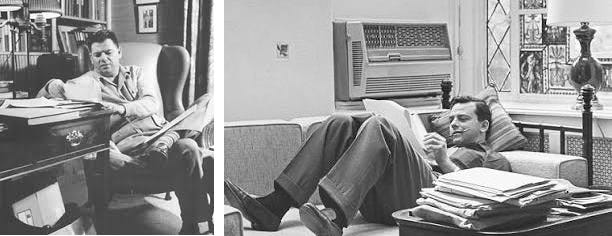
Our workshop began with a quick tour of the house, then we convened in Oscar’s living room for the writing session. We got to know one another as artists focusing on the students’ prior experience, current ideas, and expectations. The two attendees were at very different points in their journeys. One was entering her junior year of high school and just had her first theatre experience. The other was a high school graduate on the way to Temple University to study theatre. Both defined themselves as storytellers with specific messages they wanted to share, but neither had much formal experience writing plays. That didn’t matter with Oscar’s method. The focus was on the stories they planned to tell and honest conversation about the way it engages an audience. In this case, the audience was the three of us.
The first writing exercise moves writers away from the daunting largeness of writing a full play down to the most immediate moment that can set a story into action. Writers choose one simple moment in a person’s life and wrote about the circumstances surrounding that moment, or a list of how that moment might progress. Examples of these were a shared secret, a missed alarm, and a surprise birthday party. We wrote for three minutes then shared our work. We discussed character and story and theme, and finally, I asked the writers about their process. What do they think about as they write? What do they expect from the work? Why do they want to tell the stories that they tell? What did they hope to get out of the experience today?
That led to a 45-minute session and another sharing of our work. Neither writer had anything close to a “finished” piece that could be presented to an audience. But they shared the work anyway and the resulting conversation did more for them than another hour of writing alone would have. For example, the writers felt that our conversation about humor was the most inspiring. Both had elements of humor in their work, but were unsure of how well they would land with an audience. Simply making them aware of how those of us listening to the story laughed was evidence that those specific moments worked as comedy. However, I counseled that they should find ways to balance comedy with tragedy as those complimentary genres can serve to heighten the other. They should also continue to test their writing with an audience. We can’t know how an audience will react inside our minds, and a full production in front of an audience isn’t necessary either. A couple of people sitting on chairs in a living room works just fine!
It struck me, watching them light up in that conversation, that young artists of all genres don’t have enough opportunity to create a work, share it, and talk about it seriously with someone who’s paying real attention. Sondheim once lamented in an interview that contemporary theatre suffered for the lack of opportunity for new writers to experiment with an audience. “Write a play. Put it up.” was his remedy. That exchange is an overlooked part of the creative process. As we ended the workshop, both students expressed their gratitude for such an in-depth experience. I think they were amazed by how much they could do in such a short time and how much impact their work could have.
On a side note, every person who registered for this event, whether they were able to attend or not, learned of the workshop because of a prior connection to Oscar’s house. Nobody found their way cold.
We in arts education tend to see schools as the place to market our programs. School partnerships absolutely have a role to play in developing this work. From a numbers standpoint alone they provide a large target audience. However, large student populations do not always translate into large numbers of interested participants. The word of mouth draw here, while small, may indicate a better way to get young people involved, especially those students who are serious about creating new theatrical work. You know, the ones who care so much about the craft that they want to spend three hours on a Saturday afternoon writing in a Broadway legend’s old living room. Further, these writers did not know Hammerstein and his works in the way the adults accompanying them were. The legacy passed to Stephen Sondheim and beyond resonated with them more and it may also show the way toward further engagement from younger generations.